-viscosity prescription.
We take account of the radiative force
in a parametric form proposed by Chen and Marlborough (1994).
-viscosity prescription.
We take account of the radiative force
in a parametric form proposed by Chen and Marlborough (1994).
A.T. Okazaki
College of General Education, Hokkai-Gakuen University,
Toyohira-ku, Sapporo 062, Japan
A Be star has a two-component extended atmosphere, a polar region and a cool disc-like region. The polar region consists of a low-density, fast outflow emitting UV radiation. In contrast to the polar region, the disc region consists of a high-density plasma with low outflow velocity. The optical emission lines and the IR excess arise from this region. The nature of this region is not well understood, depsite that large observational efforts have been devoted to the study of Be stars. The purpose of this paper is to study the disc structure of Be stars, based on the viscous decretion disc scenario, in which the matter ejected from the star drifts outward because of the effects of viscosity and forms a disc (Lee et al. 1991).
We assume that the circumstellar disc of a Be star is
geometrically thin and isothermal.
We adopt the Shakura-Sunyaev's -viscosity prescription.
We take account of the radiative force
in a parametric form proposed by Chen and Marlborough (1994).
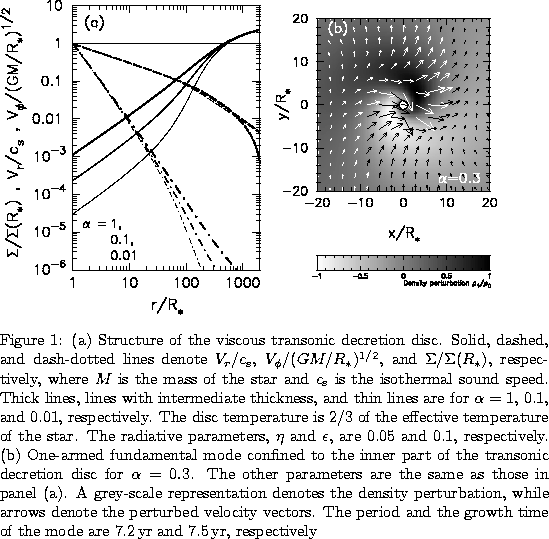
Figure 1(a) shows the structure of
the viscous transonic decretion disc
around a B0 main-sequence star.
Note that the outflow is highly subsonic
for  ,
where
,
where  is the stellar radius.
Note also that
is the stellar radius.
Note also that
 ,
,  ,
and
,
and  in the inner subsonic part,
while
in the inner subsonic part,
while  in the outer subsonic part and the supersonic part,
where
in the outer subsonic part and the supersonic part,
where  and
and  are the radial and azimuthal components
of the vertically averaged velocity, respectively,
and
are the radial and azimuthal components
of the vertically averaged velocity, respectively,
and  is the surface density.
The low outward velocity shown in Fig. 1(a),
together with the observed range of
the base density for Be-star discs (Hanuschik 1987; Dougherty 1994),
suggests that the mass loss rate in the disc region is of the order of
is the surface density.
The low outward velocity shown in Fig. 1(a),
together with the observed range of
the base density for Be-star discs (Hanuschik 1987; Dougherty 1994),
suggests that the mass loss rate in the disc region is of the order of
 to
to  even for
  .
It is important to note that
these are the basic features of
viscous transonic decretion discs.
Probing the circumstellar discs around Be stars with ISO
is therefore highly desirable
to test the viscous decretion disc scenario.
.
It is important to note that
these are the basic features of
viscous transonic decretion discs.
Probing the circumstellar discs around Be stars with ISO
is therefore highly desirable
to test the viscous decretion disc scenario.
In general, the viscous decretion discs are
overstable for m=1 perturbations.
Figure 1(b) shows an example of
the m=1 fundamental mode
confined to the inner part of a transonic decretion disc.
Notice that the perturbation pattern is leading, one-armed spiral.
The leading-spiral pattern is more remarkable in discs with
larger .